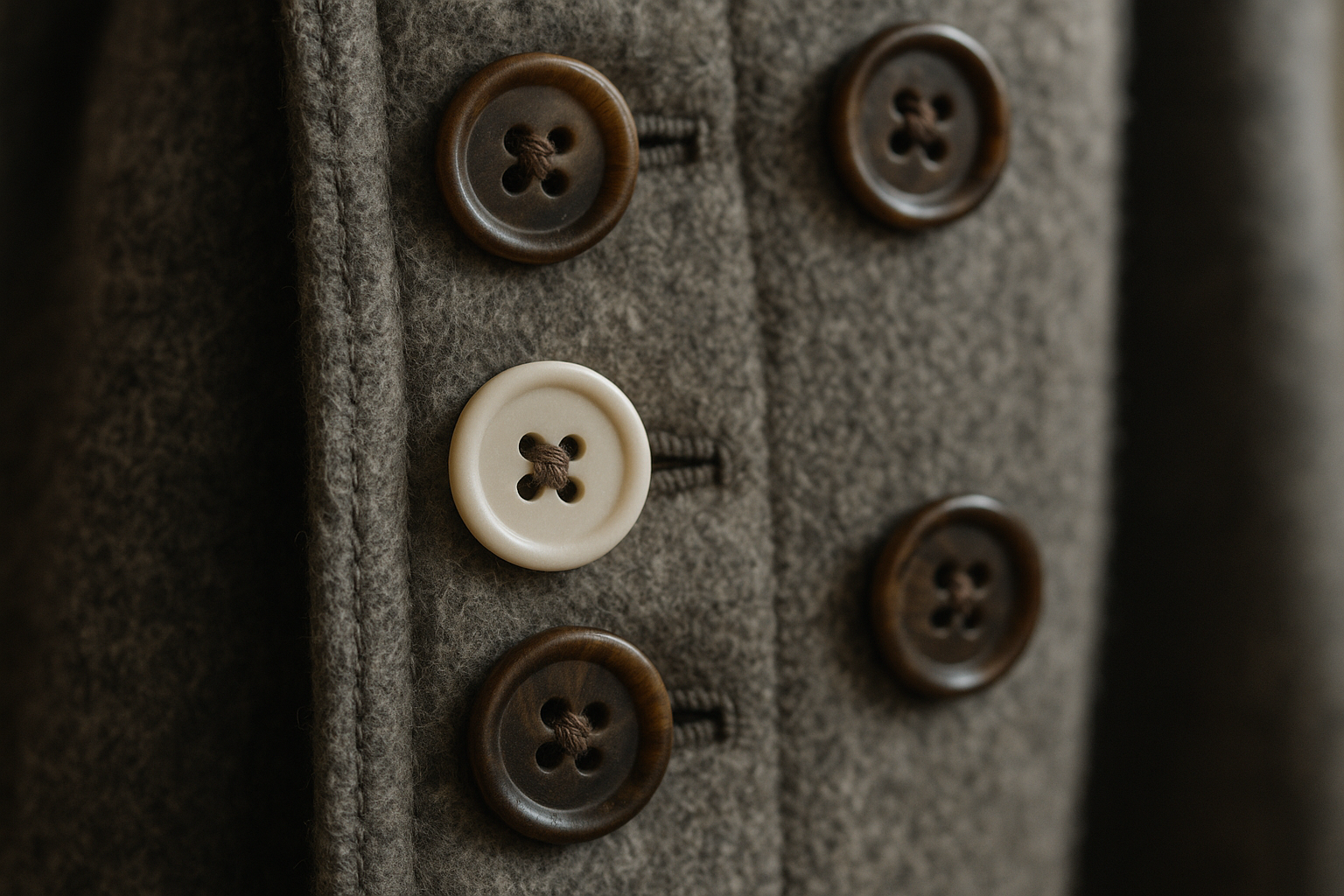
A replaced button only lowers a garment's grade when it changes function, visual match, or attachment quality — not simply because it isn't original. A matched, well-sewn replacement on a peacoat can still grade Excellent. A single mismatched button on the front placket, visible from three feet away, caps that same coat at Very Good even if every other button is original.
This trips up a lot of resellers because "non-original" gets treated as a binary disqualifier. It isn't. GradeThread evaluates buttons and hardware under two of the five weighted factors — Functional Elements and Cosmetic Appearance — and occasionally Structural Integrity if the reattachment stressed the surrounding fabric. The grade impact depends on what changed, how visible it is, and whether it still does its job.
How to Grade Replaced Buttons on Vintage Clothing
Here's the exact process we use when a garment shows non-original buttons or hardware. Work through it in order — skipping steps is how sellers end up disclosing the wrong thing or missing a grade cap entirely.
- Inventory every button, snap, zipper pull, buckle, and rivet on the garment and note which ones are original versus replaced.
- Test each replaced piece for function — does it fasten fully, hold tension, and align with its counterpart (buttonhole, snap socket, zipper track)?
- Compare each replacement visually against the originals: color, material (horn vs. plastic vs. metal), diameter, and finish (matte vs. shine).
- Inspect the attachment: hand-sewn with matching thread color reads as a quality repair; machine-stitched with mismatched thread, puckered fabric, or visible old thread holes reads as a rushed one.
- Note position and visibility. A replaced button on an interior cuff overlap is nearly invisible in wear. A replaced button on the top placket or collar is the first thing a buyer's eye hits in photos.
- Count how many buttons or hardware pieces are non-original relative to the total. One out of eight reads differently than three out of eight.
- Apply the grade cap from the table below based on the worst-scoring factor, then write the disclosure line before you shoot final photos.
Missing Button vs. Replaced Button: Different Grading Impact
These two defects get confused constantly, and they should not be graded the same way. A missing button is a Functional Elements failure — the garment cannot close or fasten as intended. A replaced button, done well, restores function; the deduction is smaller and usually lands in Cosmetic Appearance instead.
| Defect | Factor(s) Affected | Typical Grade Cap | Disclosure Required |
|---|---|---|---|
| All buttons original, fully functional | None | No cap — grade as-is (up to NWT/NWOT if otherwise pristine) | No |
| One button replaced, matched material/color, clean hand-sewn attachment | Cosmetic Appearance (minor) | Excellent | Yes — one line, factual |
| Multiple buttons replaced, all matched, consistent attachment quality | Cosmetic Appearance (moderate) | Very Good | Yes |
| One button replaced, visibly mismatched (color, material, or size) | Cosmetic Appearance (significant) | Very Good | Yes, with photo |
| Missing button, no replacement | Functional Elements | Good (single missing, non-critical position) to Fair (missing at closure point) | Yes, with photo and position noted |
| Non-original hardware that doesn't function (zipper pull that slips, snap that won't hold) | Functional Elements + Cosmetic Appearance | Fair | Yes, with function noted explicitly |
| Reattachment damaged surrounding fabric (stretched holes, visible puckering, thread ghosting) | Structural Integrity + Cosmetic Appearance | Good or lower depending on severity | Yes, with close-up photo |
Notice the pattern: function drives the floor of the grade, visibility and match drive how far above that floor you land. A perfectly functional but glaringly mismatched button will still cost you more than a slightly-off-tone one buried under a collar.
Coat Button Replacement: A Category Case Study
Outerwear is where this comes up most, because coats and peacoats often have five to eight buttons and a higher price point where buyers scrutinize every detail. We see three recurring scenarios:
- Full matched replacement set. A seller swaps all buttons on a wool coat for a correct-era horn button set because two originals were cracked. Done consistently across all buttons, this reads as a quality repair, not damage. Grade caps at Very Good rather than Excellent, since it's still a deviation from original, but it does not read as a defect in photos.
- Single mismatched replacement at the collar or top button. This is the most common return trigger we see logged. The seller replaced one lost button with whatever was in the sewing kit — often a slightly different shade or a plastic substitute on a horn-buttoned coat. Even though the coat fastens fine, the visual break is obvious in a flat-lay photo. This caps at Very Good and needs a specific disclosure line, not a generic "minor wear" note.
- Missing button with no replacement, sold as-is. If the missing button sits at a functional closure point (not a decorative sleeve button), this caps the coat at Good regardless of how clean the rest of the garment is. Buyers expect a wearable garment to close.
Coat button replacement resale value differs by tens of dollars between these three scenarios on an otherwise identical garment. We've tracked comparable vintage wool coats where a matched full-set replacement sold within 8% of an all-original comp, while a single mismatched button dropped realized price by roughly 20–25% versus that same comp — buyers negotiate hard once they spot an obvious patch job, even when it's disclosed.
Sourcing and Matching Replacement Hardware for Vintage Pieces
If you're doing the repair yourself before listing, the sourcing choice determines which row of the table above you land on. A rushed trip to the local fabric store rarely produces a match on vintage horn, bakelite, or mid-century metal hardware. Follow this sequence before you pick up a needle:
- Pull the remaining original buttons off the garment (or photograph one in hand against a ruler) and measure diameter, shank type (shank vs. flat sew-through), and material.
- Search vintage button lots by era and material — horn, bakelite, mother-of-pearl, and brass military buttons all have active resale markets, and an era-correct match costs a few dollars more but keeps the repair invisible.
- If an exact match isn't available, choose the closest neutral option (matte black horn-look resin over shiny plastic, for example) rather than the first button that technically fits the hole.
- Hand-sew with thread matched to the original stitching color, not just the fabric color — mismatched thread is often more visible than the button itself.
- Photograph the finished repair next to an original button before listing, so you have the disclosure photo ready instead of scrambling for one after a buyer asks.
This upfront work is what separates a Very Good disclosure from an Excellent one on garments where only one or two pieces needed attention.
Non-Original Hardware Beyond Buttons
Zippers, buckles, toggles, and snaps follow the same logic but weight toward Functional Elements more heavily than buttons do, because a failed zipper often means the garment can't close at all — not a partial failure like one loose button.
- Check zipper pull, teeth, and slider separately. A replaced pull with original teeth is a minor Cosmetic Appearance note. A replaced slider that skips or separates under light tension is a Functional Elements failure.
- For toggle and buckle coats, confirm the replacement matches the coat's hardware finish (antique brass vs. polished silver) since these are usually visible from a distance and read poorly when off.
- For snap closures, test each snap by hand three times. A snap that holds once but pops open on the second or third try is functionally unreliable and should be graded as Fair, not disclosed as a cosmetic quirk.
Writing the Disclosure Without Killing the Sale
Non-original hardware disclosure works best when it's specific and located, not vague. "Some wear" tells a buyer nothing and invites a return when they find something you didn't mention. Compare these two approaches:
- Weak: "Button has been replaced, still in good condition."
- Strong: "Top collar button is a non-original replacement — brown plastic vs. the original horn buttons below it. Fully functional, sewn securely. See photo 6 for close-up."
The second version does three things: names the exact defect, states the factor it affects (visual match, not function), and points to photographic proof. That combination is what keeps a Very Good grade from turning into a return request. On eBay listings, echo the same detail in the item specifics or description field rather than only the title — buyers filing not-as-described claims often point to a gap between the title and the fine print, not the fine print itself.
FAQ
Does a replaced button always lower the grade?
No. A matched, securely attached replacement that functions correctly typically only caps the grade at Excellent, not lower — the deviation from original is minor and mostly invisible in photos.
Is a missing button worse than a mismatched replacement?
Usually yes if it sits at a closure point. Missing hardware is a Functional Elements failure and can cap a garment at Good or Fair, while even a visibly mismatched but functional replacement typically caps at Very Good.
Do I need to disclose a replacement even if it's a perfect match?
Yes. Disclosure isn't just about visibility — it's about accuracy. A one-line factual note ("button X is a period-correct replacement, matched, fully functional") protects you even when the repair is undetectable in photos.
Try It on One Garment
If you've got a coat, jacket, or shirt sitting in inventory with a button you're not sure how to call, run it through GradeThread. You'll get a numbered grade, a factor-by-factor breakdown showing exactly where the replacement or missing hardware landed, and disclosure language you can paste straight into your listing — no guessing whether "Excellent" or "Very Good" is the honest call.