Why Comparing Fees Isn't as Simple as the Percentage
Every resale app publishes a headline commission number. What they don't put on the same page is:
- Whether payment processing (2.9% + $0.30, roughly) is included in that number or charged on top of it.
- Whether the fee is calculated on item price only, or item price plus shipping.
- Who pays for the shipping label, and whether the platform deducts that cost from your payout automatically or leaves you to buy it elsewhere.
- Whether there's a minimum flat fee for low-price items that makes percentage math irrelevant under $15–$20.
Two platforms can advertise similar "take rates" and still leave you with a 6-point difference in net payout on the same item, once shipping treatment is factored in. That gap is where a lot of resellers quietly underprice their inventory.
eBay Selling Fees for Clothing
eBay charges a final value fee (FVF) on the total amount the buyer pays — item price plus shipping — not just the item price. For most clothing categories, that's 13.25% up to $7,500 in a single sale, plus a flat $0.30 per order. Store subscribers get a lower percentage, and the discount scales with your plan tier — Starter runs around 13% for clothing, Basic around 12.35%, and Premium/Anchor tiers step down further. If you're listing more than a couple hundred items a month, the store subscription fee is usually cheaper than the FVF spread it saves you; run that math against your actual monthly volume before assuming a free account is fine.
Payment processing is bundled into that final value fee under eBay's managed payments system — you won't see a separate processing line, but it's priced into the 13.25%. If you use eBay's own shipping labels, the label cost is deducted from your payout automatically; if you buy labels elsewhere, you pay for them out of pocket before they ever touch your eBay balance.
Optional add-ons that change your real fee: Promoted Listings Standard (ad fee, typically 2–10% of the sale price if the ad drove the sale, billed only on a successful sale), Promoted Listings Advanced (cost-per-click, billed whether or not the item sells), and international fees if a buyer ships outside the US. None of these show up in the headline 13.25% figure, and Promoted Listings Standard alone can add 2–6 points to your effective fee on items you boost.
Poshmark Fees Explained
Poshmark's structure is the simplest to state and one of the most misunderstood in practice. Sales of $15 or more are charged a flat 20% commission. Sales under $15 are charged a flat $2.95 fee instead of a percentage — which means on a $12 item, Poshmark is effectively taking about 25% of the sale.
Shipping works differently here than on eBay or Mercari: the buyer pays a flat shipping fee (commonly $7.97) directly to Poshmark's shipping partner, separate from the item price. Poshmark provides a prepaid label to the seller at no cost, for packages up to 5 pounds. That means Poshmark's 20% is the whole fee story for a standard-weight item — there's no processing fee line and no shipping deduction from your payout, as long as you stay under the weight limit. Go over 5 pounds (a bundle of jeans, a winter coat plus accessories) and you'll owe an overage charge deducted from your payout, so weigh bundles before you list them as a single package.
Mercari Fees Explained
Mercari charges a 10% selling fee on the item price, plus a separate payment processing fee of 2.9% + $0.30 per transaction — closer to eBay's structure than Poshmark's in that processing is billed on top of the selling fee rather than folded into one number.
Shipping is seller's choice: you can pass the cost to the buyer as a separate line, or offer "free shipping" and eat a discounted Mercari label cost, which is deducted directly from your payout. Mercari's discounted labels run from roughly $4.85 for a small poly mailer up to $20+ for heavier boxes, scaled by weight. Mercari also periodically runs seller promotions (reduced selling fee for a limited window on select categories) — worth checking before you bulk-list, since a temporary rate change can shift your pricing math for that batch.
Fee Comparison Table
| Platform | Selling / Commission Fee | Payment Processing | Shipping Treatment |
|---|---|---|---|
| eBay | 13.25% of (item + shipping), up to $7,500; +$0.30/order (lower with a Store subscription) | Bundled into final value fee | Seller sets price; eBay label cost deducted from payout if used |
| Poshmark | 20% flat ($15+ sales); $2.95 flat (under $15) | Bundled into commission | Buyer pays flat shipping fee to Poshmark; seller ships free (up to 5 lbs, overage charged past that) |
| Mercari | 10% of item price | 2.9% + $0.30 per transaction | Seller choice: buyer-paid or seller-paid discounted label, deducted from payout |
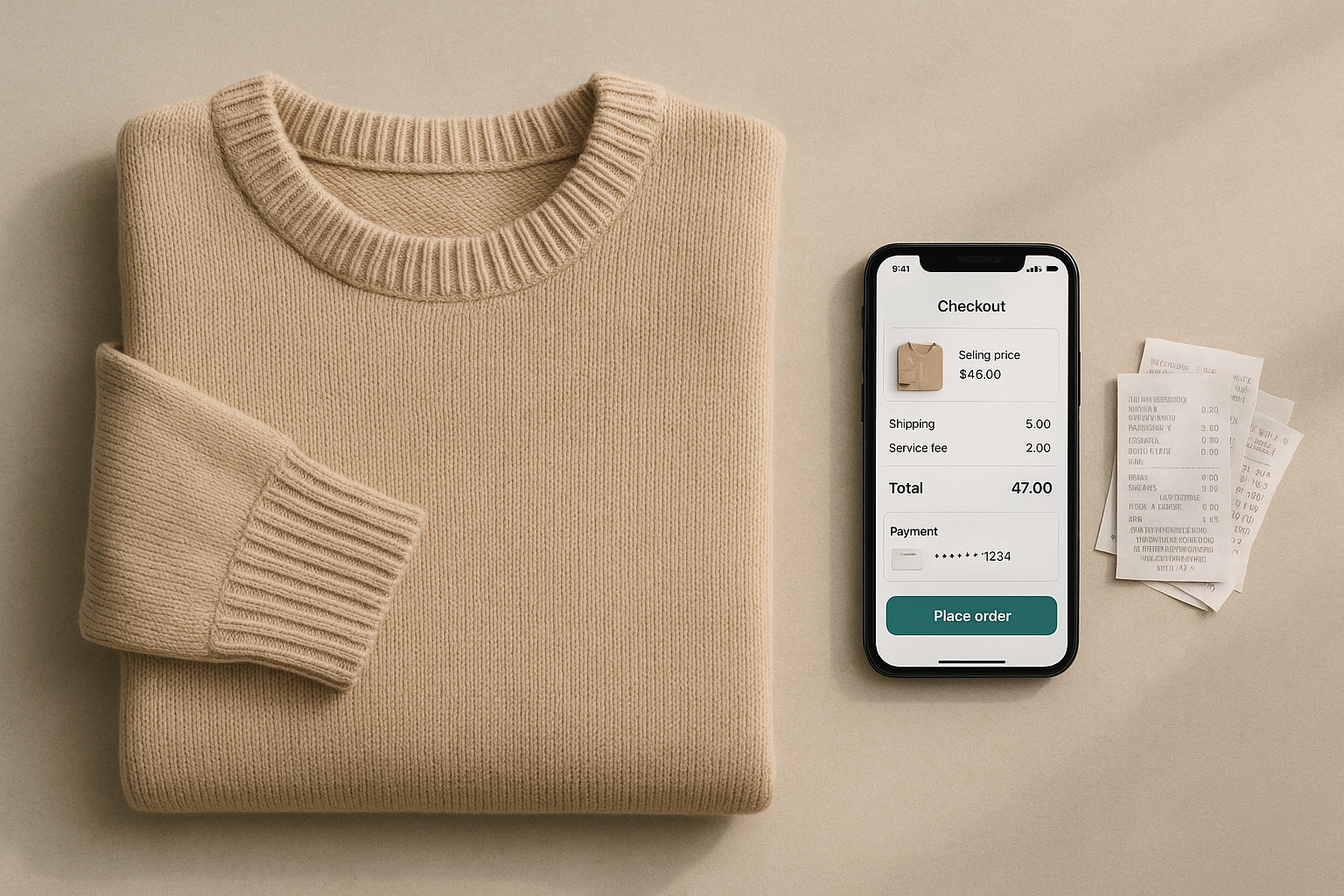
Worked Example: The Same $45 Sweater on Three Platforms
Say you sourced a sweater for $9, listed it at $45, offered free shipping to the buyer, and paid roughly $5.50 for a standard poly mailer label where the platform requires you to cover it.
| Line item | eBay | Poshmark | Mercari |
|---|---|---|---|
| Sale price | $45.00 | $45.00 | $45.00 |
| Selling / commission fee | −$5.96 | −$9.00 | −$4.50 |
| Payment processing | bundled above | bundled above | −$1.61 |
| Flat order fee | −$0.30 | — | — |
| Shipping label (seller cost) | −$5.50 | $0 (buyer pays separately) | −$5.50 |
| Payout before COGS | $33.24 | $36.00 | $33.39 |
| Cost of goods ($9) | −$9.00 | −$9.00 | −$9.00 |
| Net profit | $24.24 | $27.00 | $24.39 |
Same item, same price, same cost basis — a $2.76 swing in net profit purely from fee structure and shipping treatment. Multiply that across 200 items a month and it's the difference between a good quarter and a flat one.
Hidden and Add-On Fees That Don't Show Up in the Headline Rate
Beyond the core commission and processing lines, a few costs erode margin quietly enough that most sellers never trace them back to a specific platform decision:
- Ad spend. eBay Promoted Listings and Poshmark's Ad promotion tool both take a cut on top of the base commission when they drive the sale — treat this as a separate line, not a rounding error.
- Currency conversion. International buyers can trigger a conversion fee on top of the standard commission, usually 1.5–3%.
- Offer and discount fees. Poshmark's "Offers to Likers" and bundle discounts change the final sale price the 20%/flat-fee math runs on — a $50 item sold via a $40 accepted offer is charged fees on $40, not $50.
- Return-related costs. A refunded sale can leave you out the original outbound label, a return label, and the platform's ability to hold your commission during the dispute window — covered in more detail below.
How to Calculate Your Real Net Payout
Don't estimate this from memory per platform. Run the same steps every time you price an item, and you'll price to actual margin instead of list price:
- Start with the sale price the buyer actually pays (item price only, not including any shipping the buyer pays separately).
- Subtract the platform's selling or commission fee, calculated on whatever base that platform uses (item price alone, or item + shipping).
- Subtract payment processing separately if the platform bills it as its own line (Mercari, most independent processors) — don't assume it's bundled unless you've confirmed it.
- Subtract any ad, promotion, or offer-related fees that applied to this specific sale, not just the base commission.
- Subtract your actual shipping cost — the label you paid for, not the flat rate the buyer was charged, since those two numbers are rarely identical.
- Subtract your cost of goods (what you paid for the item, plus any cleaning, repair, or packaging materials).
- What's left is net profit per item. Log it against the SKU, not just the sale price, so your P&L reflects reality instead of gross revenue.
Why Tracking Real Net Per Item Is What Actually Matters
Fee percentages are public. What's not public — and what actually determines whether you're profitable — is your net payout after every deduction, averaged across your real platform mix. A seller running 60% eBay, 30% Poshmark, 10% Mercari has a blended fee load that's different from a seller running the reverse split, even if they're sourcing identical inventory.
There's a second cost that doesn't show up in any fee schedule: returns. A buyer who opens a not-as-described case on eBay or a case on Poshmark doesn't just cost you the item — it can cost you the original shipping label, a return label, and the commission you already paid, depending on the platform's policy. Condition disputes are the single most preventable version of this. When a garment is graded and documented consistently — using defined tiers like NWT, NWOT, Excellent, Very Good, Good, Fair, and Poor, backed by specifics on Fabric Condition, Structural Integrity, Cosmetic Appearance, Functional Elements, and Odor & Cleanliness — buyers have less room to argue the item didn't match the listing. Fewer disputes means fewer refunds eating into the net payout you worked out above.
FlipDesk's Reconcile module pulls your actual payouts, fees, and shipping costs per platform and matches them against cost basis automatically, so the net profit number you see is the real one — not the gross sale price sitting at the top of your dashboard. If you're currently eyeballing margin off list price, that's the gap worth closing first.
Try running one week of sales through Reconcile and compare the output to what you assumed your margin was. Most resellers find the real number is a few points lower than they thought — now you'll know exactly where those points went.