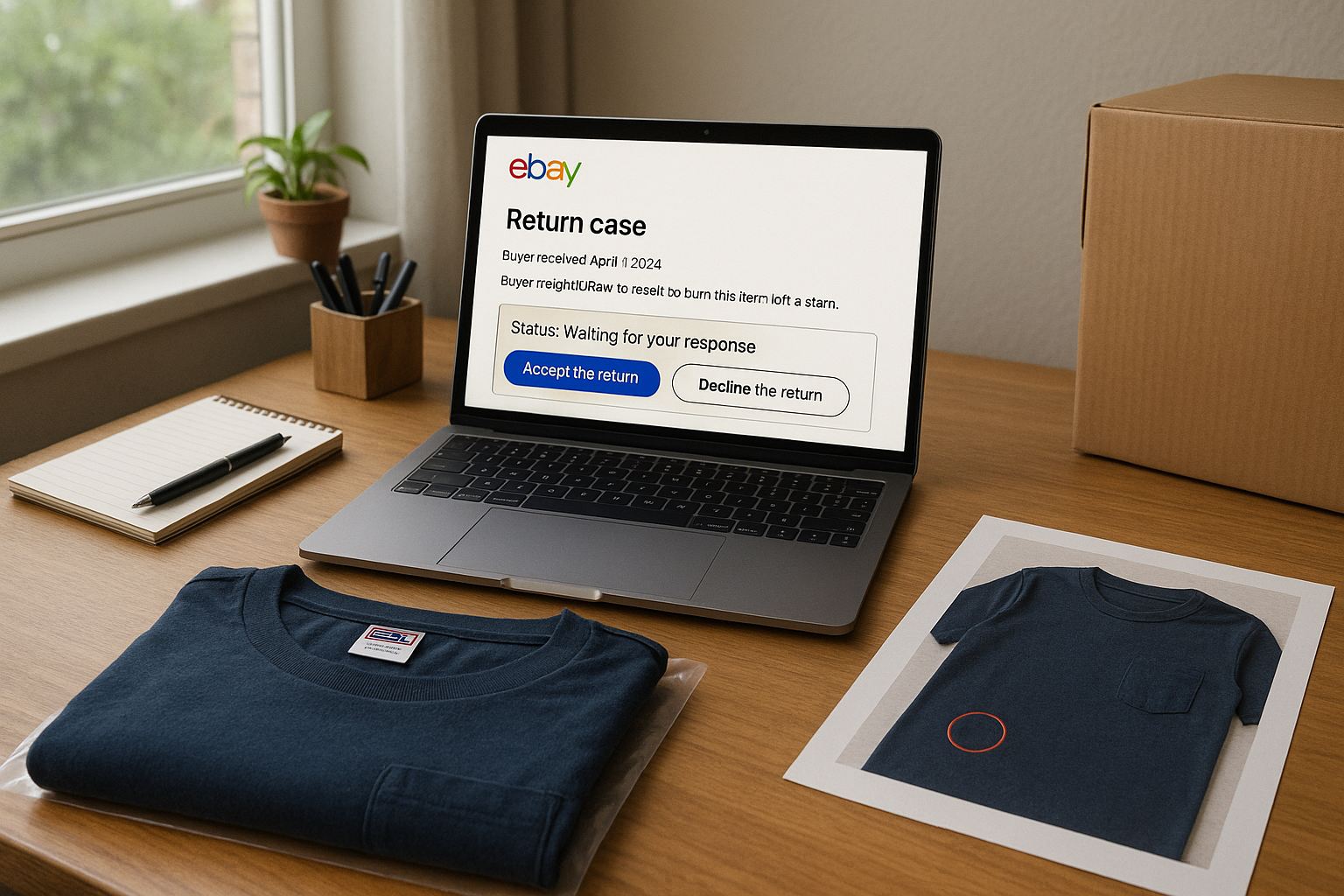
An eBay partial refund dispute is a negotiation, not an automatic buyer right. You can accept the buyer's number, counter with your own tied to a specific defect, or ask eBay to step in and decide. Who wins usually comes down to one thing: whether you documented the item's condition before it shipped. If you did, you have leverage. If you didn't, you're guessing against a buyer who has photos and you don't.
Partial refund requests are one of the most common friction points in clothing resale. A buyer doesn't want to ship the item back, because shipping is a hassle or they still want to wear it, so they ask for money back instead. Sometimes that's a fair ask for a real flaw you missed. Sometimes it's wardrobing, a buyer's remorse discount, or an attempt to squeeze margin out of a seller who won't push back. You need a process that tells the difference fast, because eBay gives you a narrow window to respond.
How eBay's Partial Refund Requests Actually Work
Under eBay's Money Back Guarantee, a buyer opens a case as "item not as described," and in many categories eBay lets them ask to keep the item for a partial refund instead of returning it. As the seller, you can accept their amount, propose a different amount, or decline and let the return process proceed. If you and the buyer can't agree, either side can ask eBay to step in. eBay then decides based on the messages, the listing, and the photos both parties submitted. Exact options and deadlines vary by category and change over time, so check the case page and eBay's current seller policy for your case.
This is the part sellers miss: eBay doesn't grade condition. It reads the evidence in the case thread. If the buyer submits three close-up photos of a stain and you submit nothing, the case reads one-sided even if your listing photos showed the item clean. The real defense starts before the item leaves your bin.
Document Clothing Condition Before Return Requests Ever Happen
The sellers who win these disputes aren't better negotiators. They have a timestamped record of exactly what shipped. Build this into intake, not into panic mode after a case opens.
- Photograph the item flat and on-form under consistent lighting before it's bagged: front, back, both sides, and the label.
- Take a dedicated close-up of every existing flaw, such as pilling, a loose thread, or a small mark near the hem. Include minor ones a casual buyer might not notice.
- Grade the item across the five condition factors: Fabric Condition, Structural Integrity, Cosmetic Appearance, Functional Elements, and Odor & Cleanliness. Then assign a tier: NWT, NWOT, Excellent, Very Good, Good, Fair, or Poor.
- Write the grade and flaw notes into the item specifics or description, not just your private notes. This is what the buyer and eBay see if a case opens.
- Save the intake photos to the SKU record, not just your phone camera roll, so you can pull them in under a minute weeks later.
- Photograph the exact item again at packing to confirm nothing changed between intake and shipment.
- Keep the records through the full return window and any dispute period, not just until delivery.
[Screenshot placeholder: SKU record showing intake photos, grade, and flaw notes]
This is the highest-leverage habit in returns reconciliation. A documented Very Good grade with a photo of a small existing mark near the cuff turns a buyer's "item arrived damaged" claim into a non-issue: the mark was disclosed, graded, and priced in. Without that record, the same claim is your word against theirs, and eBay tends to weigh the buyer's photos heavily.
The Step-by-Step Response When a Buyer Files a Partial Refund Claim
When a case lands, you have limited time to respond, commonly around 3 business days before eBay can step in on its own. Confirm the deadline shown on your case. Work it in this order.
- Read the reason code the buyer selected and their full message before reacting. "Doesn't fit" and "item arrived damaged" need completely different responses.
- Pull your intake documentation for that SKU: original photos, condition grade, and listing description.
- Compare the buyer's photos against your originals. Look for a defect in a spot your photos don't show, a different lighting angle, or a damage type that wasn't present at intake (a new stain versus an existing one you disclosed).
- Decide your position. If the flaw was disclosed and graded, decline and reference the listing. If it's plausible transit damage or something you missed, propose a partial refund tied to a specific dollar amount, not a vague percentage.
- Respond inside the case thread, not just by email or message, because eBay weighs evidence attached to the case.
- If you counter, be specific: "Original grade was Very Good with disclosed hem wear noted in item specifics. Photo submitted shows the same disclosed mark, not new damage. Declining refund, standing by listed condition."
- If you can't agree after one or two rounds, ask eBay to step in rather than waiting for the buyer to do it. This puts your documentation in front of eBay proactively.
- Log the outcome against the SKU: refund amount, reason, and whether the defect was disclosed. This feeds your per-item P&L.
Speed matters as much as substance. Cases left unanswered past eBay's deadline can be decided in the buyer's favor regardless of the facts.
Show the Math: What a Partial Refund Really Costs
Take a jacket that sold for $60. The buyer asks for $20 back and keeps the item. Depending on your fee situation, eBay's final value fee on the refunded amount may be credited back, but you should verify this on your order report rather than assume it. Your cost basis was $12. Before the refund, the sale looked like roughly $48 of gross margin before fees and shipping. After a $20 refund, that's about $28. A single accepted claim on a $60 item takes a third of your margin.
Now compare the alternative. A declined claim that escalates and loses can end in a full return, where you get the jacket back (possibly in worse shape) and pay return shipping. So the right counter is often a smaller partial refund tied to the defect, such as $8 to $10 for a flaw you actually missed. Run the numbers per case before you reply.
Valid Partial Refund Reasons vs. Return Fraud Patterns
Not every partial refund request is bad faith, and treating every buyer as a scammer costs you more in negative feedback than it saves in refunds. Use the pattern, not your gut, to sort legitimate claims from likely return fraud.
| Signal | Likely Legitimate | Likely Fraud or Abuse |
|---|---|---|
| Photo evidence | Matches a flaw you already disclosed, or shows plausible transit damage (crushed box, new crease) | Shows damage inconsistent with the garment (burn mark on a knit, cut fabric) or a different item |
| Timing of the claim | Opened within a few days of delivery | Opened near the end of the return window |
| Refund amount requested | Reasonable relative to the defect (10–25% of item price) | Near-total refund while the buyer keeps the item |
| Buyer history | Few or no prior cases on their account | Repeated item-not-as-described cases across sellers, where visible to you |
| Message tone | Specific, references the actual garment | Generic template language, no specific defect named |
None of these signals alone proves fraud. Two or three together justify declining or countering firmly, especially when your intake documentation backs you up. If you suspect abuse, report it through eBay's seller support rather than accusing the buyer in the case thread.
When to Escalate for an eBay Money Back Guarantee Decision
Escalate when you have strong documentation and the buyer won't move off an unreasonable number. Submit your intake photos, the graded condition notes, and a short factual timeline. Avoid emotional language, because eBay's review leans on documented facts, not tone. If your evidence clearly shows the flaw was disclosed at the stated grade, you have a real shot at a decision in your favor or a reduced refund. We can't promise an outcome. If your documentation is thin, escalating hands a reviewer a coin flip.
Building a System So You're Not Guessing Case by Case
Partial refund disputes feel like a fire drill because most sellers only document condition at listing time, then can't reconstruct it weeks later. The fix is treating grading and photo intake as a permanent record tied to the SKU. A standardized grade, the same NWT through Poor scale scored across Fabric Condition, Structural Integrity, Cosmetic Appearance, Functional Elements, and Odor & Cleanliness every time, gives you something consistent to point back to instead of relying on memory or a buried photo folder. That consistency also cuts your not-as-described volume, because buyers dispute less when the grade they bought matches what arrives.
FlipDesk's Reconcile workflow keeps that intake record attached to every SKU, so when a case opens you pull the original grade and photos in seconds and respond before the clock runs out. Try grading and documenting one item end to end the next time you list, and see how much faster the next dispute resolves.