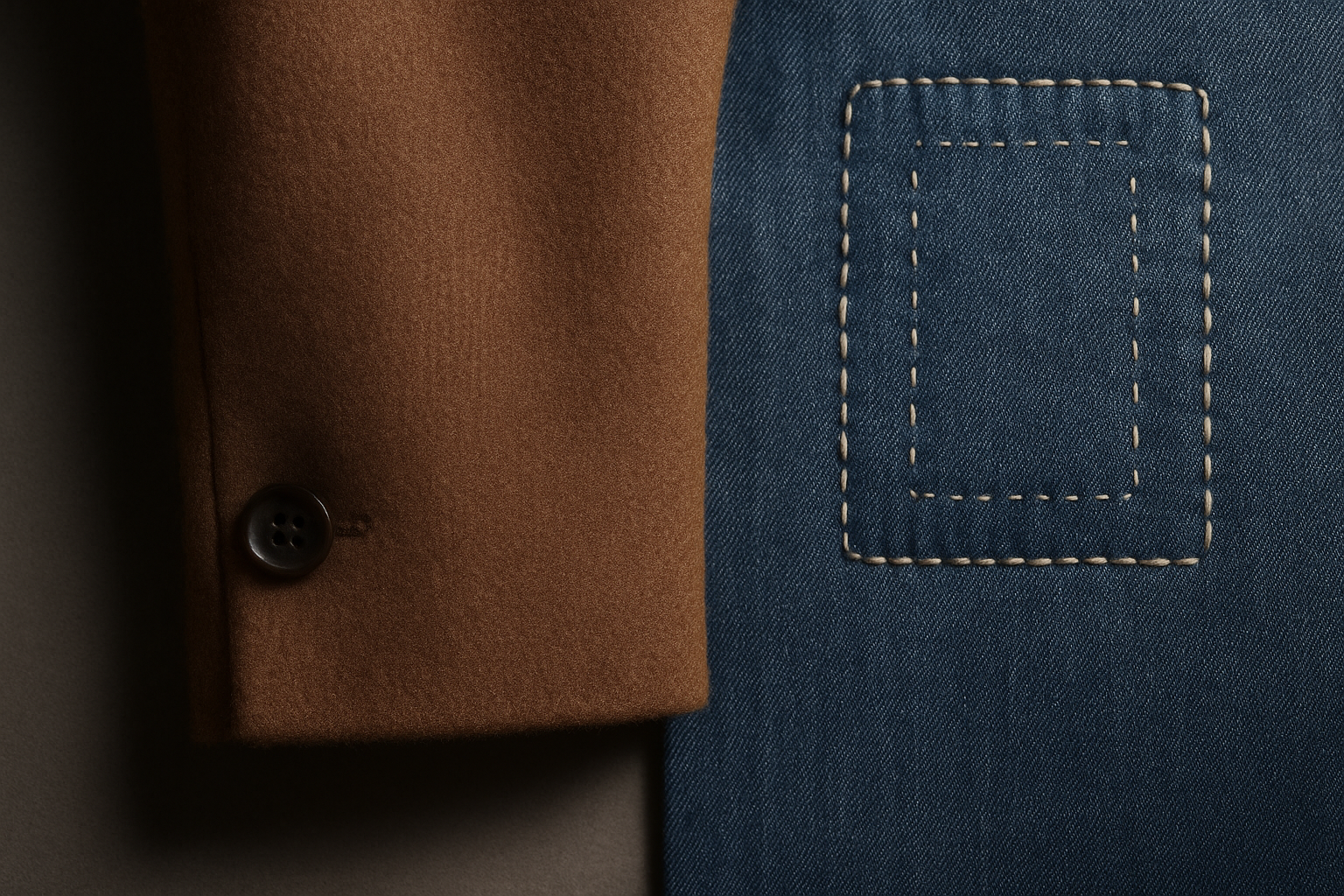
A professionally repaired garment can still grade Excellent or Very Good — a home repair rarely clears Good. The difference isn't that repairs are banned from the top tiers. It's whether the repair restores Structural Integrity and Cosmetic Appearance without leaving evidence at normal viewing distance, and whether you disclose it regardless of how good it looks.
We've seen a wool topcoat with a professionally rewoven moth hole sell as Excellent with zero return complaints, and we've seen a hand-stitched jean crotch repair — technically functional, visibly puckered — tank a listing to a Fair-condition return before the buyer even wore it. Same category of problem, opposite outcomes, because the repair quality and the disclosure were handled differently.
How to Grade Professionally Repaired Clothing for Resale
The rule we use: grade the repair the same way you'd grade the original defect it fixed, then check whether the fix itself introduces a new problem. A repair doesn't erase history — it replaces one defect (a hole, a broken zipper, a torn seam) with a different, hopefully smaller one (a patch, a replacement part, a mended seam). Your job is to grade what's actually on the garment now, not what used to be wrong with it.
That means two separate checks, every time:
- Repair quality: stitch consistency, material match, and whether it holds under stress. This is a professional-vs-home question.
- Repair visibility: whether the fix reads as a flaw at normal inspection distance (12–18 inches, the standard we use for cosmetic grading across the board). This determines the Cosmetic Appearance hit, if any.
A repair can pass quality and still fail visibility — a rock-solid patch in a loud contrasting fabric is structurally fine and cosmetically disqualifying. Grade both dimensions independently, then let the worse of the two set your ceiling.
Professional vs. Home Repairs: What Actually Differs
This is where most resellers get generous with themselves. "My aunt is really good at sewing" is not the same claim as "a cobbler resoled these with matched leather and a proper welt." Buyers can tell the difference in photos, and returns follow the ones who couldn't.
| Repair Type | Stitch Consistency | Material Match | Visible at 12–18in? | Typical Grade Ceiling |
|---|---|---|---|---|
| Professional invisible reweave (moth holes, small tears) | Matches garment thread count | Yarn-matched, same weight | No | Excellent |
| Professional cobbler resole (leather shoes/boots) | Machine-uniform | Matched sole compound | Minimal, at sole edge only | Very Good |
| Professional zipper/hardware replacement | Uniform, factory-adjacent | Exact or close match | No, if color-matched | Very Good |
| Professional visible patch (non-decorative) | Uniform but contrasting | Deliberately different | Yes | Good |
| Home hand-stitched seam or tear repair | Uneven stitch length | Often off-shade thread | Yes, usually | Good to Fair |
| Home iron-on patch | N/A, adhesive-based | Rarely matched, glue visible | Yes | Fair |
| Unrepaired functional failure (pinned, taped, held with a clip) | None | None | Yes | Poor |
Notice the pattern: professional repairs earn a higher ceiling because they're consistent and matched, not because a professional touched them. A sloppy tailor job still grades like a home repair. Credentials don't matter — execution does.
Repair Quality Grading Standards We Use
"Professional" is a claim, not a grade. Before you let a repair carry the ceiling it implies, verify it against a short checklist rather than taking a seller's or thrift tag's word for it:
- Thread match under raking light — hold the garment at an angle to a light source. Mismatched sheen or slightly-off dye lot shows up here even when it's invisible under flat overhead light.
- Stitch density — count stitches per inch against the surrounding factory stitching. A hand repair almost always runs looser or more irregular, even from a skilled hobbyist.
- Edge finishing — professional reweaves and patches finish the repair edge so it doesn't fray further; home repairs often leave a raw or overlapped edge that will degrade with wash cycles.
- Stress recovery — gently stretch the repair site and let it relax. A quality repair returns to shape; a marginal one shows permanent puckering or a stretched halo around the stitching.
- Reverse-side inspection — check the inside of the garment, not just the face. Bulky knots, visible fusible interfacing, or exposed adhesive on the reverse side are a home-repair tell even when the front looks clean.
If a repair fails two or more of these checks, treat it as a home repair for grading purposes regardless of who did the work or what the listing claims.
The Five Factors Repairs Touch Most
Every grade we issue weighs Fabric Condition, Structural Integrity, Cosmetic Appearance, Functional Elements, and Odor & Cleanliness. Repairs almost always touch more than one:
- Structural Integrity — does the repair actually hold weight and stress, or is it cosmetic-only? A resewn seam that pops under a light tug hasn't fixed the underlying failure; it's delayed it.
- Fabric Condition — check the fabric around the repair, not just the repair itself. Puckering, glue bleed-through, or a stiffened patch zone all count against fabric condition even if the repair site holds.
- Cosmetic Appearance — the visibility test at 12–18 inches. This is where most home repairs lose the most ground.
- Functional Elements — for zippers, buttons, snaps, and clasps: does the replaced part actually function through a full open-close cycle, or does it catch, stick, or misalign?
- Odor & Cleanliness — adhesive repairs and dry-cleaning chemicals used in professional restoration can leave a chemical smell that needs to air out before you photograph or ship. Check it separately from the repair quality itself.
Step-by-Step: Grading a Repaired Garment
- Identify every repair location on the garment, including ones not mentioned by the source (thrift tags rarely disclose alterations).
- Run the repair quality checklist — thread match, stitch density, edge finishing, stress recovery, and reverse-side inspection — to confirm whether it's genuinely professional-grade.
- Test structural hold at each repair site — gentle stress test on seams, full cycle test on zippers and closures.
- Inspect each repair under raking light at 12–18 inches to judge stitch consistency and material match.
- Classify each repair as invisible, minor visible, or major visible based on that inspection.
- Cross-reference the repair against the five factors and note which factor takes the biggest hit.
- Assign the garment's overall grade based on the worst-affected factor, not an average.
- Disclose every repair in the listing description, regardless of the final grade tier.
- Photograph each repair site clearly, in addition to your standard shot list, so buyers see exactly what you graded.
Visible Mending Disclosure vs. Condition Grade
Here's the distinction resellers most often get backwards: visible mending disclosure and condition grade are two separate obligations. The grade tells a buyer how the garment performs and looks. The disclosure tells them what happened to it. An Excellent-grade garment with an invisible professional mend still needs the words "professionally repaired" in the listing — the grade doesn't substitute for the history.
We've watched sellers reason that if a repair is truly invisible, there's nothing to disclose. That's backwards. Invisibility affects the Cosmetic Appearance score. It doesn't erase the fact that a garment was damaged and fixed, which some buyers — vintage collectors, archival buyers, anyone paying a premium for originality — will weight heavily regardless of how the repair looks. Non-disclosure on a repair that's later discovered (a buyer's tailor points it out, or a seam separates along the old repair line under normal wear) reads as concealment, not oversight, and that's the kind of return that turns into a negative review instead of a quiet refund.
The safe, simple standard for repair transparency vs. condition grade: disclose the repair location and type in plain language — "professionally rewoven small hole near left hem, not visible in wear" — and let the grade carry the condition assessment. Buyers who don't care will skip past it. Buyers who do care will thank you for saying it upfront instead of finding it themselves. On eBay, put this in the item specifics' condition description field, not just the body text — buyers filtering by condition rarely scroll the full description before clicking away.
Grade Ceiling by Repair Scenario
To make the ceiling concrete, here's how we call the most common repair situations we see across denim, outerwear, knitwear, and footwear:
- Professional invisible reweave on a wool moth hole — Excellent is achievable if no other issues exist.
- Professional cobbler resole with matched compound and clean welt — Very Good ceiling, since the sole is technically new material.
- Professional zipper replacement, exact color and tooth match — Very Good, assuming full function.
- Professional but visible patch (non-decorative denim knee, elbow) — Good ceiling, even with flawless stitching.
- Designer-intentional visible patching or distressing sold as-is — grade against the design intent, not as damage; disclose as manufacturer detail, not repair.
- Home-sewn seam repair with visible, uneven stitching — Good at best, Fair if stitching is loose or thread doesn't match.
- Home iron-on patch with visible glue edge or heat discoloration — Fair, regardless of how well it's holding.
If a repair is purely functional and unaddressed cosmetically — a safety pin standing in for a missing button, packing tape reinforcing a seam — that's not a repair, that's a Poor-tier structural failure waiting for a real fix.
Try It on One Repaired Garment
Repairs are the gray area every experienced reseller argues about internally — good enough to sell as Excellent, or a Good-tier item wearing a professional's polish? Run one repaired garment through GradeThread and see how the report scores each of the five factors independently, including the repair site. You'll get a grade you can defend and disclosure language you can paste straight into the listing.